
We were delighted to meet many of our readers at the Extraction 2025 mining industry trade show in November, and to renew acquaintances with longtime partners and customers. For those readers unfamiliar with the applications of FRP to the mining industry, however, we would like to highlight some of the benefits of the material as compared to steel.
FRP consists of glass fibers embedded in a polymer resin matrix, typically polyester, vinyl ester, or epoxy. This composite structure creates a material that combines the strength of glass fibers with the corrosion resistance and moldability of plastics. In mining environments where equipment faces constant exposure to corrosive chemicals, abrasive materials, moisture, and temperature extremes, FRP provides durability that can significantly outlast conventional steel or alloy components while reducing maintenance costs and downtime.
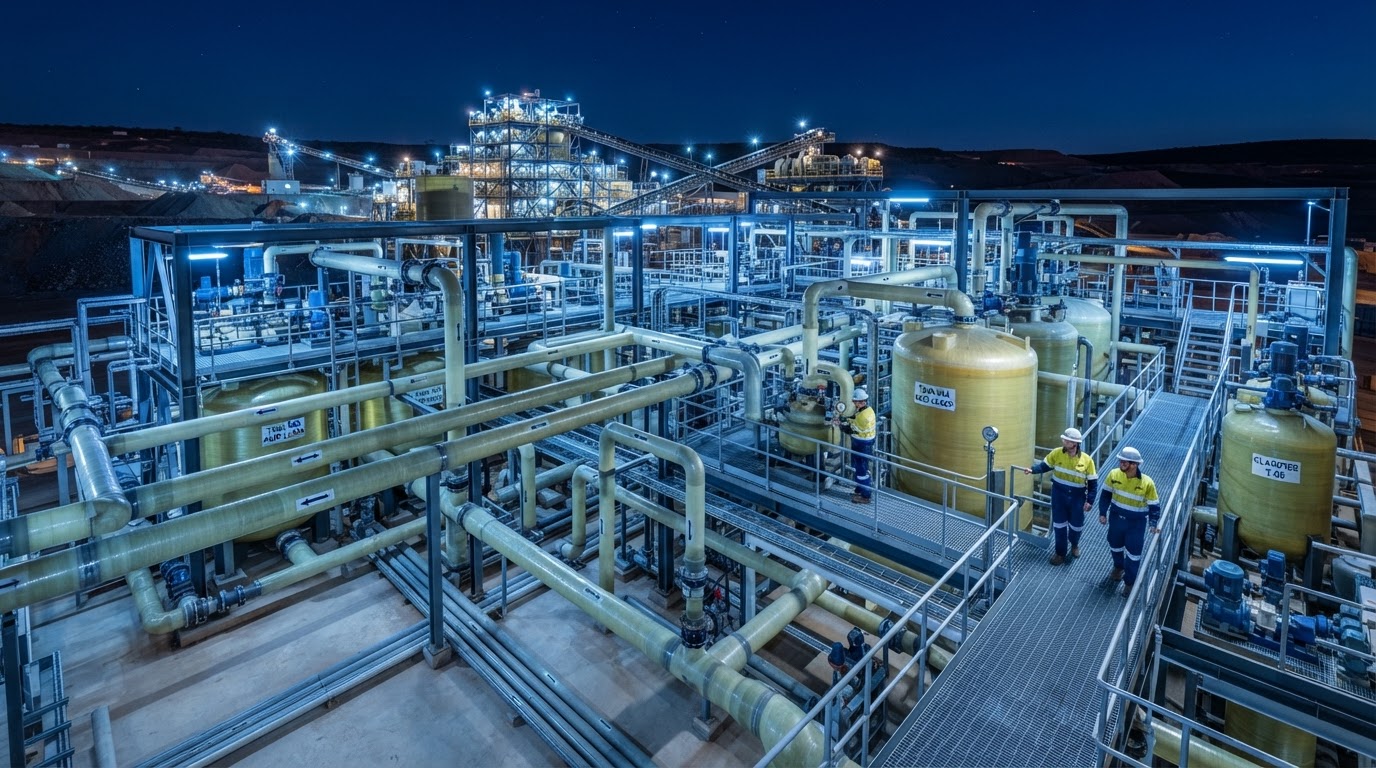
One of the primary applications of FRP in mining is in piping systems and storage tanks for handling corrosive process fluids. Mining operations frequently use aggressive chemicals such as sulfuric acid for solvent extraction, hydrochloric acid for rare earth processing, and various flotation reagents for mineral separation. Steel and lined pipes in these applications suffer from rapid corrosion, requiring frequent replacement and creating safety risks from leaks. FRP piping systems resist chemical attack, maintain structural integrity over decades of service, and weigh about 75% less than steel equivalents, making them easier and less expensive to install and support. The smooth interior surface of FRP pipes also reduces friction losses and prevents scale buildup, improving flow efficiency in slurry transport systems.
FRP grating, handrails, and structural platforms represent another significant use case in mining facilities. Mineral processing plants require extensive walkways, stairs, and work platforms in areas where metal structures quickly deteriorate from humidity, chemical exposure, and corrosive gases. FRP structural components provide excellent strength-to-weight ratios, offering sufficient load-bearing capacity while weighing only about one-quarter as much as steel. The non-conductive properties of FRP also enhance electrical safety in areas where workers might encounter exposed wiring or electrical equipment. Additionally, FRP grating features slip-resistant surfaces and doesn’t require painting or coating, reducing long-term maintenance requirements in facilities that operate continuously.
The material’s design flexibility has led to innovative applications in equipment components such as ventilation ducting, scrubber systems, and equipment covers. Modern mining ventilation systems often transport air laden with moisture, dust, and corrosive fumes that would rapidly degrade metal ductwork. FRP ducts maintain their structural properties in these conditions while allowing for custom fabrication to fit complex mine layouts. In air pollution control systems, FRP scrubbers effectively handle acidic or alkaline gas streams that would corrode metal vessels, providing reliable performance in meeting environmental regulations. Mining equipment manufacturers also increasingly use FRP for protective covers and housings for process equipment where the material’s moldability allows for ergonomic designs while its durability protects sensitive components from harsh mining environments.
The adoption of FRP in mining continues to expand as the industry recognizes both the operational and economic benefits. While initial material costs for FRP can be higher than traditional metals, lifecycle cost analyses consistently demonstrate substantial savings through reduced maintenance, longer service life—often decades under proper conditions—and decreased installation labor due to lighter weight. The material’s immunity to galvanic corrosion simplifies system design when integrated with metallic components. As mining operations push into more challenging environments with increasingly aggressive chemical processes, FRP provides engineers with a proven solution that enhances safety, reduces environmental risks from leaks and failures, and improves overall operational efficiency. The continued development of higher-strength resins and improved manufacturing techniques promises to further expand FRP’s role in mining applications.