
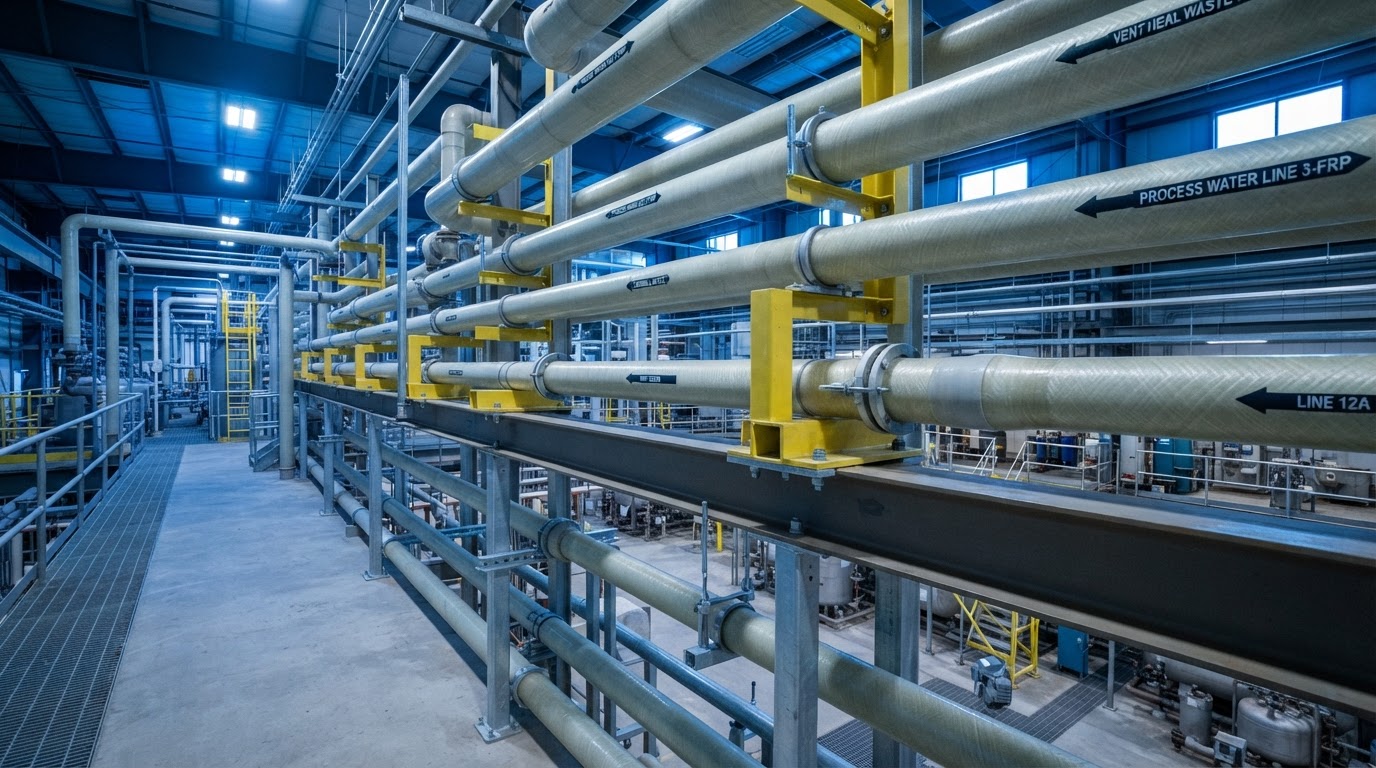
Fiberglass‑reinforced plastic (FRP) has become one of the most durable and dependable materials used in corrosive fluid handling, often delivering service life far beyond what steel can achieve in the same environments. The secret lies in the fundamental nature of FRP itself: it is a composite engineered from glass fibers and thermoset resins, resulting in a material that does not corrode the way metals do. Where steel reacts aggressively with seawater, acids, chlorides, and oxidizing agents, FRP remains chemically stable. This inherent immunity to corrosion dramatically slows the degradation process, which is why FRP tanks and piping systems often remain in service for 20, 30, or even 40 years with minimal intervention.
Another contributor to FRP’s longevity is its highly customizable construction. Unlike steel, which is typically manufactured from standardized material compositions, FRP can be tailored to match the chemistry and temperature of the specific process environment. Engineers can modify the resin type, corrosion barrier thickness, fiber orientation, and overall laminate structure to optimize performance for sulfuric acid, sodium hypochlorite, brine, or hundreds of other corrosive solutions. By building the material “from the inside out,” each FRP component is engineered for the exact conditions it will face. This level of customization helps prevent the localized corrosion, pitting, and stress cracking that often shorten the life of steel.
FRP also provides a significant mechanical advantage through its laminate structure. The glass fibers offer high tensile strength, while the resin matrix distributes loads and protects the fibers from chemical attack. This composite structure allows FRP to maintain strength even when subjected to cyclic loading, vibration, or thermal changes. Steel, by comparison, often loses wall thickness due to corrosion long before its mechanical properties become a concern. FRP’s ability to maintain structural integrity without thinning or rusting plays a key role in its extended service life.
The corrosion barrier inside FRP tanks and piping systems is another major factor in their durability. This barrier – typically made using corrosion‑resistant resins and glass veil – acts as a shield between the process fluid and the structural laminate. Even if the equipment handles aggressive chemicals at elevated temperatures, the corrosion barrier protects the load‑bearing layers from degradation. Steel systems, even when lined or coated, are vulnerable to coating failures, pinholes, under‑film corrosion, and mechanical damage that quickly propagate into full‑scale deterioration. Conversely, FRP does not rely on a bonded coating to resist corrosion; the barrier is part of the laminate itself, making it far more durable and less susceptible to catastrophic failure.
One often-overlooked contributor to FRP’s lifespan is its resistance to environmental degradation. Steel structures in coastal, humid, or chemically rich atmospheres can corrode even when empty, and external corrosion under insulation is a constant threat. FRP, however, is not prone to atmospheric corrosion and does not degrade from moisture exposure. Its stability under UV and weathering, especially when protected with gel coats or UV inhibitors, ensures outdoor installations maintain their structural integrity and appearance for decades. This resilience further reduces maintenance burdens and life‑cycle cost compared to steel.
Finally, FRP’s long service life is reinforced by proper engineering practices, including stress analysis, support design, and periodic inspection – all services in which Maverick boasts decades of experience. While FRP itself is highly durable, systems that are engineered specifically around its material properties tend to achieve the longest service lives. When designed and supported correctly, FRP tanks and piping exhibit minimal wear and almost no corrosion-related failures. This combination – material durability, chemical resistance, structural stability, and tailored engineering – explains why FRP continues to outperform steel in the most demanding corrosive environments, and why Maverick’s expertise can help your project outlive even the best steel systems.